
Why making time for friends is so hard
Six adults, one dinner, and the science of time management.

Imagine six friends trying to arrange dinner.
Friday works for two. Saturday works for four, but not the same four who can do Sunday. Someone suggests next week. Someone asks which restaurant. By the time the last person replies, the first person’s availability has changed.
Everyone wanted to go. Nothing was booked.
This is an imagined scene, not a field experiment. But it raises a useful question: what if managing time involves more than becoming better at managing your own calendar?
Research on planning offers several pieces of the answer. We can underestimate how long things take, leave intentions without a next step, and make leisure feel surprisingly like work. Add other people’s schedules, and there is a separate problem: finding time that overlaps.
What is time management actually for?
Time management advice often begins with output: finish more tasks, reduce wasted minutes, fit more into the day.
A 2021 meta-analysis by Brad Aeon, Aïda Faber and Alexandra Panaccio examined 158 studies covering 53,957 participants. Time management was moderately associated with work performance, academic achievement and well-being. The authors found a somewhat stronger relationship with well-being than with performance. 1
That does not establish that a better calendar makes someone happier. Much of the evidence was correlational, and results varied substantially between studies. People with more control over their lives may also find planning easier.
Still, the findings invite a better personal question: is your planning helping you spend time on what matters to you?
For our six friends, the desired outcome is simple. They want an evening together. A beautifully organized individual calendar cannot, by itself, deliver that.
The mathematics of finding one shared evening
Here is a deliberately simplified model. Suppose each person has a 50% chance of being free on a particular evening, independently of everyone else.
For two people, the chance that both are free is 25%. For six people, the chance that everyone is free is about 1.6%.
The calculation is P(everyone free) = pⁿ, where p is each person’s availability probability and n is the number of people.
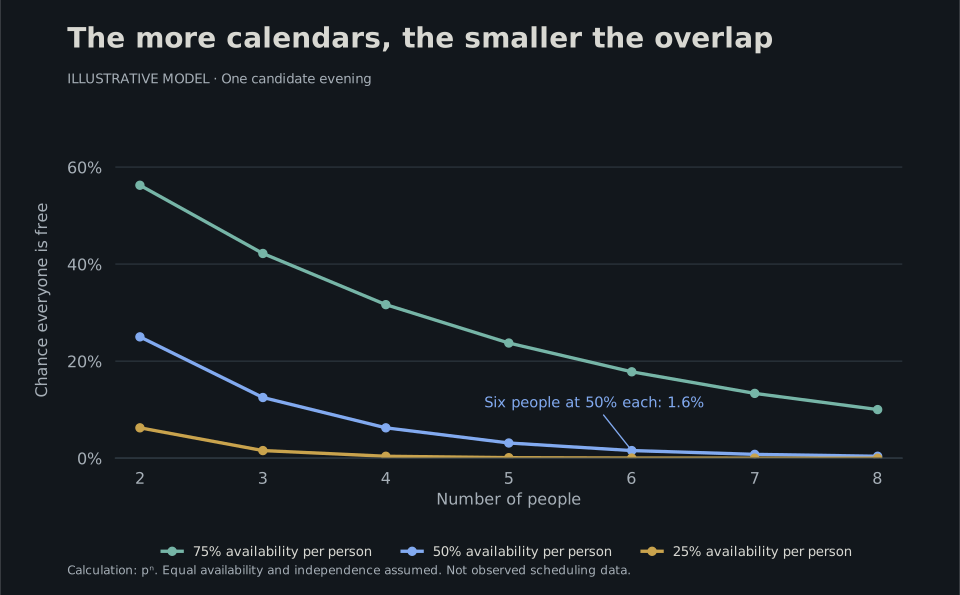
Real friends do not have independent schedules. Weekends, school holidays and shared routines create overlap; conflicting shifts can remove it. The curves are not forecasts for your group.
They illustrate why adding people introduces a different task. You are looking for an intersection between schedules. Being personally free more often helps, but it is not the same as finding a shared opening.
For the dinner, a practical response is to put a few concrete options in front of everyone at once. This is a coordination suggestion, not a result tested by the model. A poll can reveal an overlap; it cannot create one where none exists.
Tomorrow’s calendar can be too optimistic
Another difficulty starts before the invitation: the time we think we will have.
In a 1994 study, Roger Buehler, Dale Griffin and Michael Ross asked students when they expected to finish their honours theses. Among the 33 students included in the completion-time averages, the best estimate was 33.9 days. Actual completion averaged 55.5 days. Even the average pessimistic estimate, 48.6 days, was shorter than the actual mean. 2
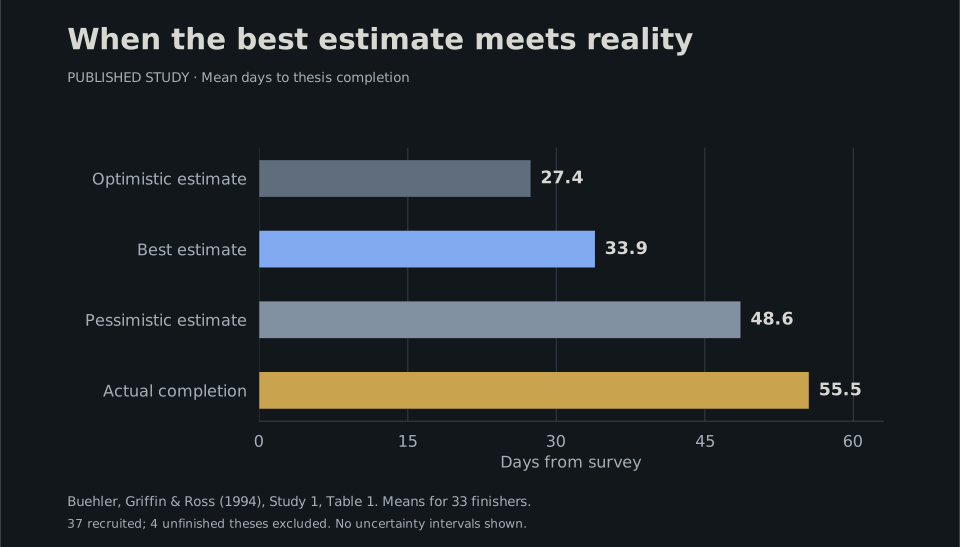
This small student sample is not a formula for how much buffer everyone needs. It illustrates the planning fallacy: our forecasts can underweight the delays that shaped previous attempts.
Before promising an evening after a demanding day, look at a comparable day you actually lived. When did work finish? How long did the journey take? What else needed doing? Let that experience inform the plan.
Give good intentions a next step
“We should meet soon” expresses something meaningful. It still leaves the next action undecided.
Research on implementation intentions examines plans that connect a situation to an action: if a particular cue occurs, then I will do a particular thing. A 2006 meta-analysis by Peter Gollwitzer and Paschal Sheeran brought together 94 independent tests and reported a positive average effect on goal attainment, d = 0.65. That is a standardized effect size, not a 65% improvement or success rate. 3
The studies covered different goals and settings, rather than testing this dinner scenario. A reasonable application would be: “After dinner tonight, I will send three possible dates.” It gives the organizer a specific action to take.
There may also be an attention benefit. In experiments published in 2011, E. J. Masicampo and Roy Baumeister found that making specific plans reduced the intrusive thoughts and interference associated with unfinished goals in the tasks they studied. 4
That does not mean writing a task down completes it, or that an app will eliminate mental load. It suggests that deciding how to act can help us stop repeatedly reconsidering an unfinished intention.
For our group, the useful next step might be a message that names the options, asks everyone to respond by Thursday, and says who will confirm the booking. These details are an editorial application of the research, not a scientifically validated dinner protocol.
Plan enough to meet, and leave room to enjoy it
There is a complication: precise scheduling can change how leisure feels.
In a 2016 paper, Gabriela Tonietto and Selin Malkoc reported that scheduling leisure could make it feel more like work. One study offered students free coffee and a cookie, either at a specific chosen time or within a two-hour window. 5
The result contains a revealing trade-off. Exact-time tickets were redeemed more often: 33 of 67, compared with 21 of 81 flexible-window tickets. Among those who attended, average enjoyment was lower in the exact-time group: 6.48 versus 7.57 on a 1–9 scale.
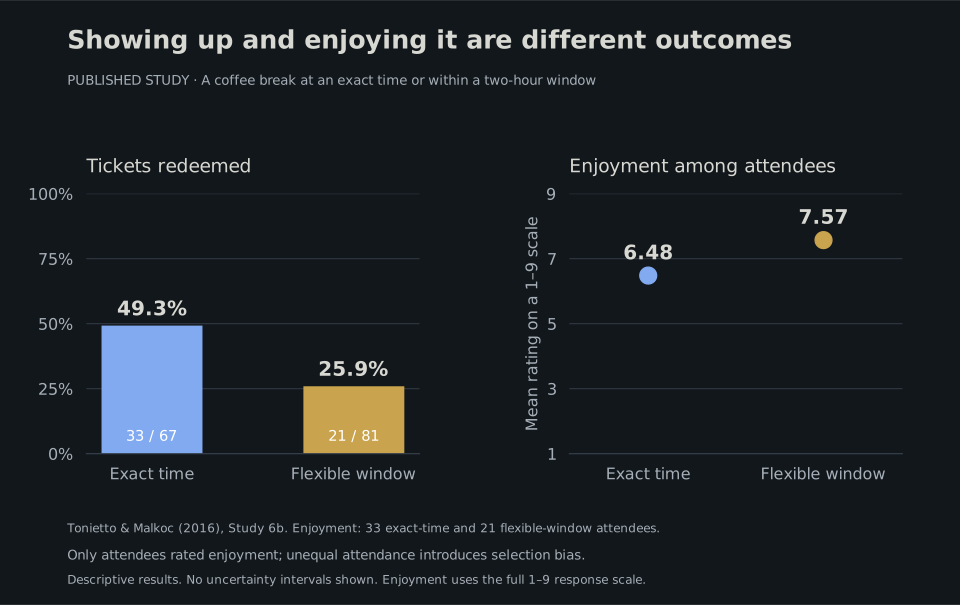
The finding suggests a balance. Coordinate what needs agreement, while allowing flexibility where possible. A reservation needs a time. A walk may accommodate an arrival window. Neither requires turning every moment together into an itinerary.
A small experiment for your next invitation
Try this with one plan you have been postponing. This is a personal exercise inspired by the research, not a tested intervention.
- Name the occasion. Choose something you actually want to do: dinner, a walk, a visit. Decide what would make it worthwhile.
- Check real constraints. Include travel, caring responsibilities and recovery time. An empty calendar entry does not necessarily mean usable time.
- Offer a few feasible options. Let people compare the same choices. Allow a clear “none of these” response.
- Finish the decision. Agree who will confirm the date and when. If no option works, change the time, duration or format together.
- Keep the experience spacious. Once the necessary details are settled, leave room for conversation and changes of mind.
Afterwards, ask whether the plan happened and how the process felt. You do not need to calculate your productivity. You need to know whether organizing helped you do something you valued.
No planning method removes an inflexible shift, a lack of childcare or exhaustion. Those are real constraints. A cancelled plan is not evidence of a personal failure.
Return to the six friends. Success is a date they can agree on, a plan they can trust, and an evening they enjoy. The calendar has done its job when they can put it away.
Sources and how to read the evidence
This is a research-informed blog article, not original research or a systematic literature review. It combines selected peer-reviewed studies, an explicitly hypothetical mathematical model and practical interpretation. Published findings do not establish that any particular app improves well-being or friendships.
- Aeon, B., Faber, A., & Panaccio, A. (2021). Does time management work? A meta-analysis. PLOS ONE, 16(1), e0245066. Open-access paper.
- Buehler, R., Griffin, D., & Ross, M. (1994). Exploring the “planning fallacy”: Why people underestimate their task completion times. Journal of Personality and Social Psychology, 67(3), 366–381. DOI. Author-uploaded full text.
- Gollwitzer, P. M., & Sheeran, P. (2006). Implementation intentions and goal achievement: A meta-analysis of effects and processes. Advances in Experimental Social Psychology, 38, 69–119. DOI. University-hosted full text.
- Masicampo, E. J., & Baumeister, R. F. (2011). Consider it done! Plan making can eliminate the cognitive effects of unfulfilled goals. Journal of Personality and Social Psychology, 101(4), 667–683. DOI. Author-hosted manuscript.
- Tonietto, G. N., & Malkoc, S. A. (2016). The calendar mindset: Scheduling takes the fun out and puts the work in. Journal of Marketing Research, 53(6), 922–936. DOI. University-hosted full text.