
The quieter month that never comes
Why we keep promising time to a future version of ourselves who seems much less busy.

On Tuesday evening, Anna gets a message: could she help organize a neighbourhood dinner next month?
She looks at her calendar. This week is impossible. Next month looks almost empty.
“Of course,” she writes. “Things should have calmed down by then.”
It is an easy promise to make. The dinner sounds lovely. There will be people she wants to see. And the person who will have to arrange it lives four weeks away, in a much quieter part of her imagination.
Four weeks later, that person is Anna.
She is standing in a supermarket queue, answering a question about dietary requirements, remembering an unfinished work task and wondering why she volunteered. Nothing especially dramatic has happened. Life has simply continued.
Anna is fictional. The mismatch between the week she imagined and the week she has to live is the subject of a surprisingly revealing line of research.
The promise
Start with what Anna saw when she opened the calendar: empty space.
Her current week had names attached to it. A meeting. A delivery. A school appointment. The later week had fewer entries, but she treated that lack of information as available capacity.
In a 2005 paper, Gal Zauberman and John Lynch investigated expectations of spare resources, which they called “slack.” Across seven experiments, they explored how those expectations shaped decisions about time and money. 1
In the first experiment, 76 students compared today with the same weekday a month later. On a scale from 1, meaning much more available today, to 10, meaning much more available next month, the mean rating was 8.2 for time and 7.0 for money.
Both resources looked more plentiful later. Time looked especially promising.
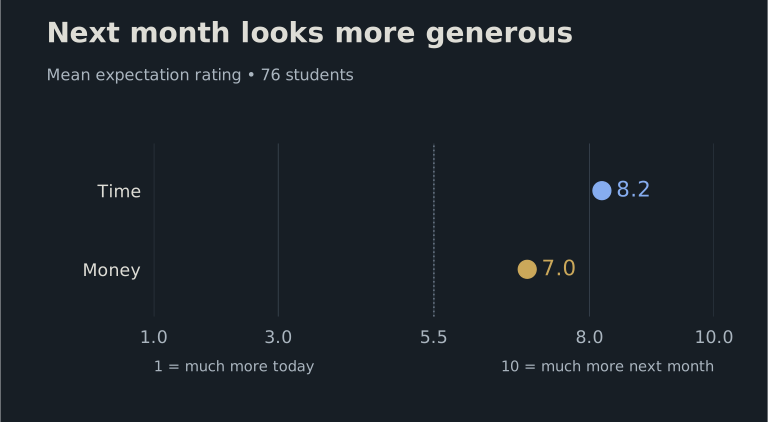
The experiment measured expectations, not whether participants actually became less busy. Its value here is narrower: it makes visible the assumption behind Anna’s reply.
She had not identified which demands would disappear. She had noticed that many demands had not yet acquired dates.
The dinner went into the empty space. A few days later, a work commitment went beside it. Then another invitation arrived. Each decision was small enough to look reasonable on its own.
The details arrive later
For a while, Anna enjoys the thought of the dinner. She imagines a long table and people staying after the plates are cleared.
Then the date gets closer. Someone needs a lift. The venue wants a final headcount. The food has to arrive before six, which means leaving work earlier, which means finishing something the previous evening.
The lovely part is still there. It now has instructions attached.
That shift resembles a pattern studied by Nira Liberman and Yaacov Trope. Their 1998 research found that distant decisions placed relatively more weight on desirability, while nearer decisions placed relatively more weight on feasibility. In one study involving a real choice of academic assignments, interest mattered more for a distant assignment; difficulty mattered more for a near one. 2
Applied to Anna’s story, the question has moved from “Would this be worthwhile?” toward “How will I make this work on Thursday?” The research does not make her earlier enthusiasm false. It helps explain why enthusiasm alone was incomplete preparation.
There is a good reason not to turn this into a rule to decline everything. Many worthwhile experiences involve inconvenient journeys, preparation or a tired evening. If Anna considered only immediate effort, she might miss things she genuinely values.
The problem is that, when she said yes, the pleasure had a vivid picture and the effort barely had a sketch.
By the time both pictures are clear, other people are relying on her.
Even the gaps feel smaller
On Thursday afternoon, Anna has an hour before she needs to leave. She could begin the task she has been avoiding. Instead, she checks the dinner messages again.
She tells herself there is no point starting anything now.
An upcoming commitment can affect how the preceding time feels. In a 2019 paper, Gabriela Tonietto, Selin Malkoc and Stephen Nowlis examined intervals that ended in a scheduled task. 3
In one hypothetical-choice study with 200 participants, people chose between a 30-minute task paying $2.50 and a 45-minute task paying $5. Of those imagining an hour bounded by a scheduled task, 78% chose the longer option, compared with 91% in the unbounded condition.
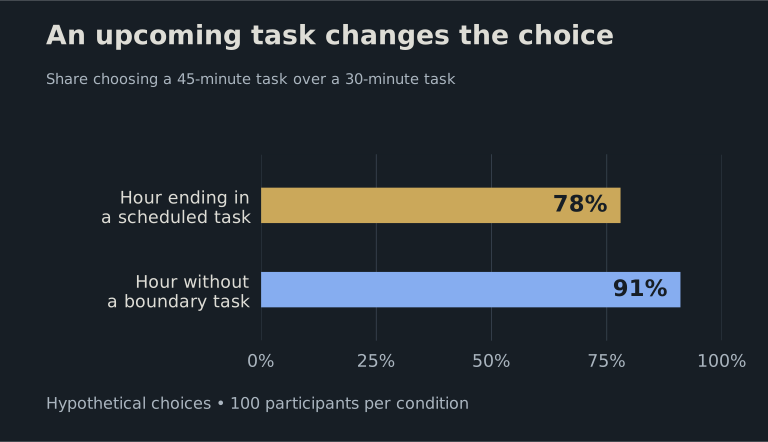
The result does not mean that a meeting destroys the hour before it. It suggests that a boundary can influence what people are willing to start within the available time. Anna’s hesitation is an illustration of that possibility, not a diagnosis.
Now her week has a peculiar shape. There are still blank spaces on the screen. But she experiences some as waiting, some as travel, and some as the only chance to sit down.
This is where simply counting unbooked hours stops being very helpful. The question is whether those hours can support the activity she wants to put in them.
Asking a better question before saying yes
Suppose we return to the first Tuesday. The message arrives again. Anna opens the same calendar.
This time, she does something slightly different. Before answering, she looks at an ordinary recent Thursday, including the parts she never bothered to record. Finishing work. Getting home. Eating. Dealing with the small things that somehow require attention every day.
Then she places the dinner inside that day.
This is a practical exercise suggested by the research, not an intervention tested by these three papers. Its purpose is to give a distant commitment enough detail to judge.
She asks herself: what will make that week less busy than this one?
There might be a concrete answer. A project will end. Someone else will cover a responsibility. She will be on leave. If so, expecting more room may be sensible.
“It is a month away” is a weaker answer.
Next, she follows the commitment beyond its title. Organizing dinner means agreeing a date, finding a place, collecting replies and making decisions when plans change. She does not need an elaborate estimate. She needs to notice what she is accepting.
Finally, she asks what she is willing to move to make room. Perhaps the dinner matters enough to take an evening she had hoped to keep free. Perhaps she would enjoy attending but cannot carry the organizing work. Either answer is more useful than assuming the cost will disappear with distance.
Her reply changes:
“I’d love to help. I can collect everyone’s availability, but I can’t arrange the food as well. Can someone take that part?”
The dinner still happens. Her contribution has edges she can see.
A promise you can recognize when it arrives
Four weeks later, Anna is still busy. Planning has not removed her responsibilities, and a clear boundary cannot solve every shortage of money, support or control over working hours.
But this time, she is checking replies rather than discovering an entire job hidden inside a cheerful message.
At the dinner, someone asks whether they should do it again. Anna wants to say yes. She has enjoyed the evening, and she knows that a calendar with no commitments would also be a calendar missing some of the things she cares about.
So she asks who will organize it, checks the dates and decides what she can contribute.
The future still contains possibilities. She is simply giving the person who will live there a say in the promise.
Research notes and sources
Anna’s story is invented to connect the findings. This article is a narrative interpretation of three selected peer-reviewed papers, not a systematic review or a test of any app. The studies examine particular populations and tasks; they do not establish that everyone overcommits or that next month cannot be quieter. Graphs show published sample results, without invented uncertainty intervals. Practical suggestions are identified as interpretation.
- Zauberman, G., & Lynch, J. G., Jr. (2005). Resource slack and propensity to discount delayed investments of time versus money. Journal of Experimental Psychology: General, 134(1), 23–37. DOI. Full paper. Figure 1 uses Experiment 1, pp. 25–26: 95 recruited, 76 complete questionnaires, means 8.2 and 7.0; SD 2.9 for both.
- Liberman, N., & Trope, Y. (1998). The role of feasibility and desirability considerations in near and distant future decisions: A test of temporal construal theory. Journal of Personality and Social Psychology, 75(1), 5–18. DOI. University abstract. The discussion draws on the reported direction of the findings, including Study 4, without claiming a numerical effect.
- Tonietto, G. N., Malkoc, S. A., & Nowlis, S. M. (2019). When an hour feels shorter: Future boundary tasks alter consumption by contracting time. Journal of Consumer Research, 45(5), 1085–1102. DOI. Full paper. Figure 2 uses Study 2A, p. 1090: 78 of 100 versus 91 of 100 selecting the longer task. These are hypothetical choices, not observed earnings or completed work.